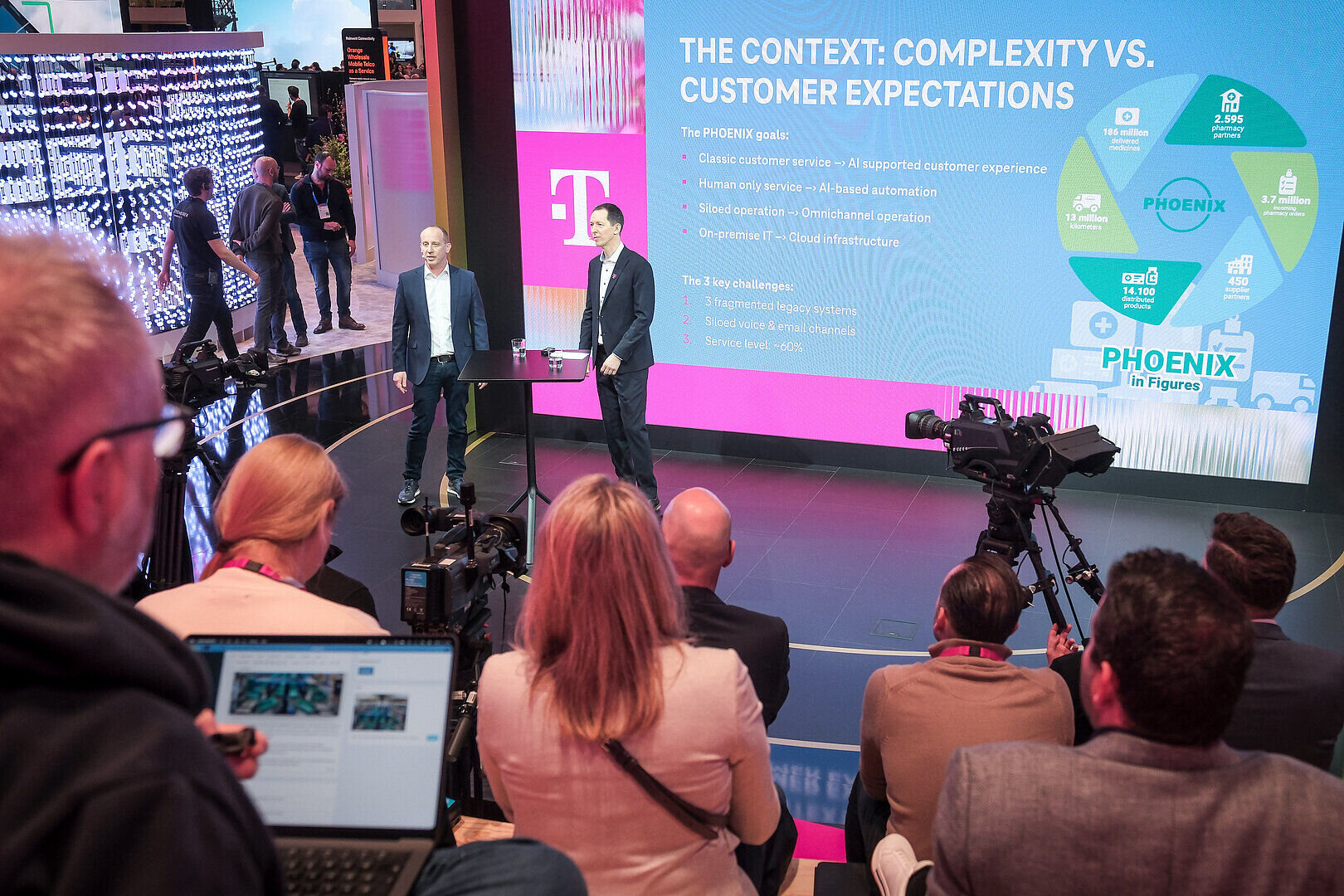
AI Customer Service in practice: Phoenix Pharma’s Legacy System Modernization
Customer service is a decisive factor in how companies compete. According to Appinio, 71% of customers choose a retailer because of good customer service. This makes service quality not just an operational concern, but a core business driver—directly influencing revenue, customer loyalty, and brand perception.
This dynamic is most visible in industries where customer service has a direct impact on business continuity. In pharmaceutical wholesale, for example, contact centers are key to order processing, ensuring that hospitals and pharmacies receive critical supplies on time.
Despite this importance, many companies still rely on systems that were never designed to work together. Voice, email, and digital channels often operate in parallel rather than as part of a unified process. Over time, these fragmented structures become firm fixtures, making change difficult—even when performance begins to decline.
The transformation project implemented by Phoenix Pharma in Hungary illustrates how AI customer service, combined with enterprise AI integration and legacy system modernization, can address these challenges and move beyond incremental improvements.

The Limits of Legacy System Environments
By 2024, Phoenix Pharma’s contact center operations had reached a critical point. The company was running three separate legacy systems, with no integration between voice and email channels. This fragmentation affected both internal processes and customer experience. Service Level performance was stuck around 60%, limiting the company’s ability to respond efficiently to time-sensitive orders.
This situation highlights a common problem for companies in all kinds of different sectors. Namely, that although delaying or not fully implementing legacy system modernization allows systems to continue working, inefficiencies accumulate over time.
From Integration to Operational Change
The transformation project at Phoenix Pharma didn’t start with AI alone. The first step was structural and involved consolidating fragmented systems into a unified platform. Magyar Telekom implemented a Cisco Webex Contact Center solution, integrating it directly into Phoenix Pharma’s existing Pharma Log system and enhancing it with proprietary AI capabilities. This laid the foundations for enterprise AI integration, embedding AI directly into operational workflows instead of treating it as an external layer.
One of the most obvious changes was the introduction of AI-based voice authentication. Traditional systems often rely on multi-step DTMF menus, adding friction and increasing handling time. Phoenix Pharma replaced this with a system that identifies customers based on their voice and spoken input. This reflects a broader shift in AI customer service, as companies turn identification and routing into real-time, data-driven processes.

“The system identifies customers based on their voice and spoken data. It significantly speeds up the process and eliminates admin work for our agents before the conversation even begins. They know who’s calling and what they need the moment they pick up.”
Marik Csaba
Regional IT Director, Phoenix Pharma
Omnichannel Contact Center Solutions
After launching the voice channel, Magyar Telekom integrated chat and email into the same platform, creating a unified environment for managing all customer interactions. This transitioned their system toward an omnichannel contact center solution, enabling consistent communication across channels and improving coordination between teams. For agents, it means full visibility across interactions. For customers, it reduces delays and inconsistencies caused by disconnected systems.
Another step in the optimization process toward AI customer service was automating high-frequency, repetitive tasks. The VIP portal password reset process was previously handled manually and required several minutes of agent time per request. The process is now fully automated thanks to the introduction of an AI-powered voicebot.
After the customer provides their email address verbally, the system verifies their identity, generates a new password, and sends it to them immediately. This change has cut processing time down from five minutes to under one minute—without any human intervention. Although these individual changes may be small, optimizations like these significantly increase efficiency when applied at scale.
Supporting Agents with AI
Phoenix Pharma is also implementing a Knowledge Base within Telekom’s CoMind platform, which processes internal documentation and provides real-time answers during customer interactions. This avoids agents having to carry out manual searches and ensures consistent, compliant communication. In this context, enterprise AI integration extends beyond automation and becomes part of everyday decision-making.
“If an agent gets stuck on a complex issue or is unsure about a procedure, they can find the answer instantly using the chatbot interface. This reduces wait times for the customer and ensures the information we give is 100% accurate and compliant.”
Marik Csaba
Regional IT Director, Phoenix Pharma
Measurable Business Impact
The results of the transformation are measurable. Service Level performance improved from around 60% to over 90%, as three legacy systems were consolidated into a single integrated platform. This consolidation also introduced greater transparency in performance and reporting, enabling more effective operational management. Moreover, Phoenix Pharma has created a scalable foundation for further development, including integration with Microsoft Dynamics 365 and expanded AI chatbot capabilities.
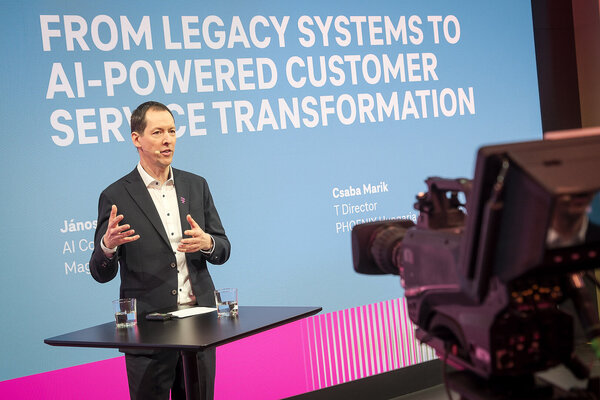
Supporting AI customer service
The Phoenix Pharma transformation highlights a broader shift in how organizations approach customer service. As systems become more complex and customer expectations continue to rise, incremental improvements are no longer enough. Companies need to fundamentally rethink how they structure their customer-facing operations to combine AI customer service, enterprise AI integration, and legacy system modernization into a cohesive model.
This is where finding the right technology partners become critical. Transformations like these require teams to seamlessly integrate connectivity, platforms, and AI capabilities into existing enterprise environments while ensuring security, compliance, and scalability. This is where Deutsche Telekom comes in. With its AI Competence Center operating across multiple European markets and a strong partner ecosystem, Telekom focuses on turning use cases into production-ready solutions embedded in real business operations.
This approach was also reflected at Mobile World Congress 2026, where the focus was not on isolated AI applications, but on how AI can be scaled across industries in a secure and operationally reliable way. The Phoenix Pharma project has shown not only what this looks like in practice but also that Deutsche Telekom and Magyar Telekom are trusted end-to-end AI transformation partners for mission-critical B2B environments.
